
AI Is the Pilot Now — Why the Human Became the Bottleneck
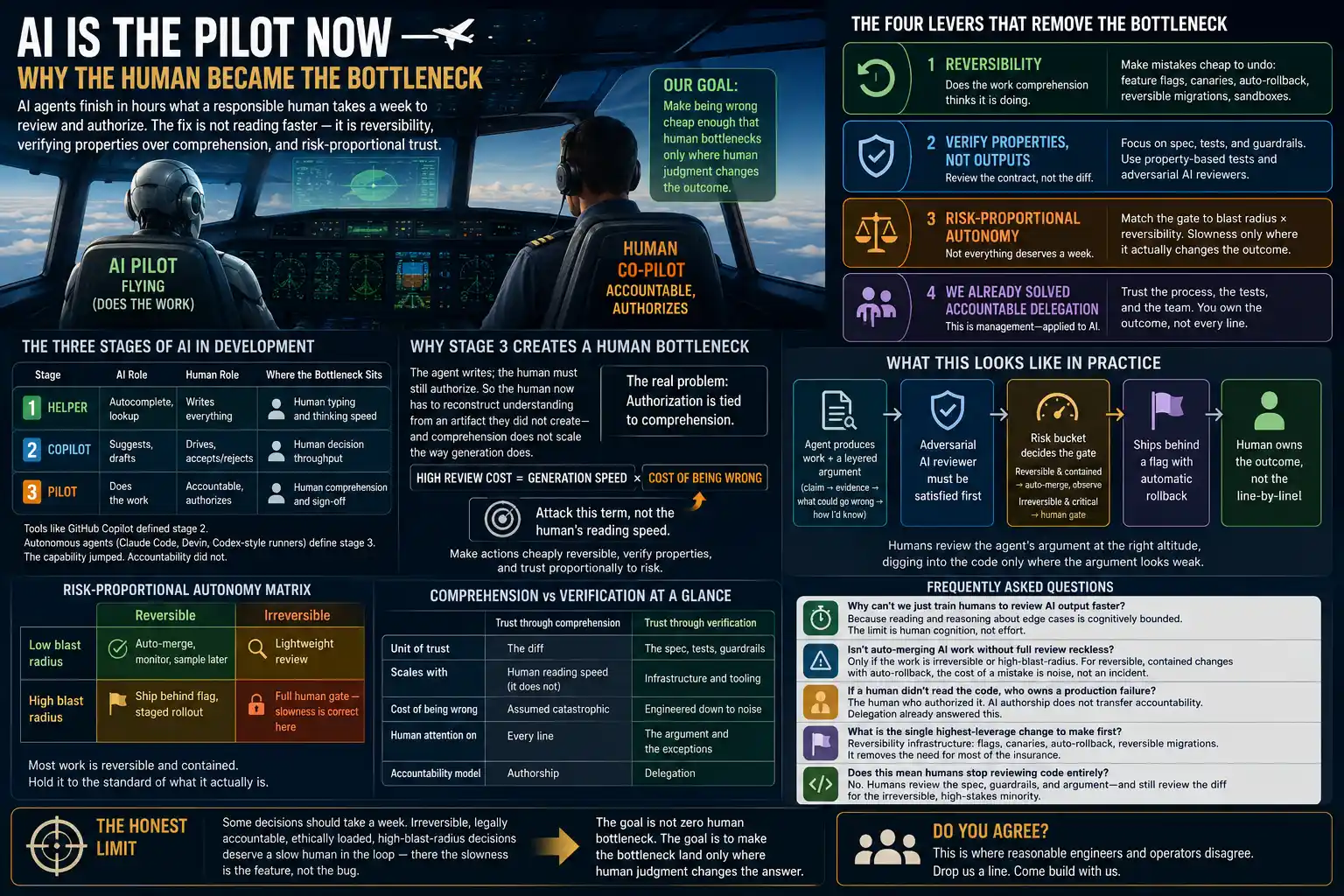
AI agents finish in hours what a responsible human takes a week to review and authorize. The fix is not reading faster — it is reversibility, verifying properties over comprehension, and risk-proportional trust.
Software development has moved through three stages with AI. First AI was a helper — autocomplete, snippets, a faster reference manual. Then it became a copilot — suggesting whole functions while the human drove. We are now in the third stage: AI is the pilot, and the human is the co-pilot. The agent does the work; the human is responsible for it.
And that is exactly where the new bottleneck appears. An agent can complete a body of work in hours. But because a human is accountable for it, that same work can sit for a week while the human reads, understands, and authorizes it. The machine got faster. The approval did not.
In stage 3, the constraint is no longer how fast the work gets done. It is how fast a responsible human can agree to be responsible for it.
The instinct is to make the human read faster. That instinct is wrong, and this post argues for what actually works instead.
The Three Stages of AI in Development
The progression is worth naming precisely, because each stage moved the bottleneck somewhere new.
| Stage | AI role | Human role | Where the bottleneck sits |
|---|---|---|---|
| 1. Helper | Autocomplete, lookup | Writes everything | Human typing and thinking speed |
| 2. Copilot | Suggests, drafts | Drives, accepts/rejects | Human decision throughput |
| 3. Pilot | Does the work | Accountable, authorizes | Human comprehension and sign-off |
Tools like GitHub Copilot defined stage 2. Autonomous coding agents — Claude Code, Devin, OpenAI Codex-style runners — define stage 3. The capability jump was real. The accountability model did not jump with it.
Why Stage 3 Creates a Human Bottleneck
The bottleneck is structural, not a sign of a slow reviewer. Throughout the entire history of software, the person who understood the code was the person who wrote it. Authorization was free because comprehension was a by-product of authorship.
Stage 3 severs that link. The agent writes; the human must still authorize. So the human now has to reconstruct understanding from an artifact they did not create — and comprehension does not scale the way generation does. You can 10x how fast code is produced. You cannot 10x how fast a human reads, reasons about edge cases, and accepts personal liability for them.
This is why "review faster" fails as a strategy. Nobody reviews ten times faster. The throughput ceiling is human cognition, and you cannot buy your way through it by trying harder.
The Real Problem: Authorization Is Tied to Comprehension
Here is the reframe that actually unlocks the problem. We have fused two things that do not have to be fused: authorizing work and comprehending work line by line.
We do not actually operate this way for most complex systems we depend on. Nobody audits the assembly output of the GCC or LLVM compiler before shipping a binary. We trust it through track record, a test suite, and an invariant: if it compiles and the tests pass, it is almost certainly fine. Trust moved up a level of abstraction. The same move is available here.
Comprehension does not scale. Reversibility, verification, and accountability structures do. The entire solution is shifting the price of trust away from the thing that cannot scale.
Four levers do that, roughly in order of impact.
Lever 1: Reversibility Does the Work Comprehension Thinks It Is Doing
Start here, because this is the highest-leverage move and it is mostly infrastructure, not AI. Ask why a review takes a week. Most of that time is not comprehension — it is insurance against an irreversible mistake.
If the agent ships behind a feature flag, to a canary, with automatic rollback on a metric regression, the cost of being wrong collapses from "incident" to "noise." You are no longer authorizing the change. You are authorizing the ability to detect and undo it. That is a far cheaper thing to be responsible for.
High review cost  =  Generation speed  ×  Cost of being wrong
                                              ↑
                  Attack this term, not the human's reading speed
Engineering effort spent making actions cheaply reversible buys back more human time than the same effort spent making explanations clearer. Feature flags, canary deployments, blue-green releases, reversible migrations, sandboxed execution — these are not just reliability practices anymore. They are the throughput strategy for stage 3.
Lever 2: Verify Properties, Not Outputs
Review the contract, not the diff. The human's attention should move to the specification, the test suite, and the guardrails — the net the work cannot fall through — rather than every line of the work itself.
This is the compiler model applied deliberately. The agent's job becomes making its work verifiable by construction: strong types, property-based tests, simulations, and independent adversarial AI reviewers it has to satisfy before a human ever looks. You are not reading the work. You are reading the conditions under which the work is allowed to ship.
This pairs naturally with using AI to review AI. A separate agent — ideally a different model, to avoid correlated failure — red-teams the first one's output. Humans then spot-check the reviewers and handle escalations, which is a dramatically smaller surface than reviewing everything directly. We explored a related version of this in Will AI Agents Replace CI/CD Pipelines.
Lever 3: Risk-Proportional Autonomy
Not everything deserves a week. The core error is taxing all work at the rate of the most dangerous work. Bucket decisions by blast radius × reversibility and let the autonomy follow.
| Reversible | Irreversible | |
|---|---|---|
| Low blast radius | Auto-merge, monitor, sample later | Lightweight review |
| High blast radius | Ship behind flag, staged rollout | Full human gate — slowness is correct here |
Most work is reversible and contained, and is currently being held to the standard of the irreversible and catastrophic. The bottleneck should still exist — just only in the bottom-right cell, where a human staring at the problem genuinely changes the outcome.
Lever 4: We Already Solved Accountable Delegation
"I am responsible for work I did not personally write and do not fully understand" is not a new problem. It is called management, and organizations have run on it for a century.
A staff engineer approving a pull request does not grok every line. They trust the author, the process, the tests, and the team's ability to detect and recover from failure. Stage 3 is not a novel crisis — it is delegation. We simply have not ported the social technology of delegation onto AI agents yet.
The aviation metaphor in the pilot/co-pilot framing actually proves the point. An autopilot flies most of a modern flight. Pilots do not review each control input — they monitor, manage exceptions, and own the outcome. Aviation solved shared control with single-point accountability through Crew Resource Management and flight-envelope protection. The pattern exists; software has not adopted it.
What This Looks Like in Practice
Concretely, a stage-3 team that has removed the bottleneck looks like this:
Agent produces work + a layered argument
  (claim → evidence → what could go wrong → how I'd know)
        ↓
Adversarial AI reviewer must be satisfied first
        ↓
Risk bucket decides the gate
  reversible + contained → auto-merge, observe
  irreversible + critical → human reviews the ARGUMENT, not the diff
        ↓
Ships behind a flag with automatic rollback
        ↓
Human owns the outcome, not the line-by-line
Note what the human reviews in the critical path: the agent's argument, at the right altitude, with progressive disclosure into the code only where the argument looks weak. Review time is dominated by reconstructing intent from artifacts. If the agent produces the rationale, the human reviews a tight argument in minutes instead of a sprawling diff in days.
Comprehension vs Verification at a Glance
| Trust through comprehension | Trust through verification | |
|---|---|---|
| Unit of trust | The diff | The spec, tests, guardrails |
| Scales with | Human reading speed (it does not) | Infrastructure and tooling |
| Cost of being wrong | Assumed catastrophic | Engineered down to noise |
| Human attention on | Every line | The argument and the exceptions |
| Accountability model | Authorship | Delegation |
The Honest Limit
Some decisions should take a week. Irreversible, legally accountable, ethically loaded, high-blast-radius decisions deserve a slow human in the loop — there the slowness is the feature, not the bug. The goal was never zero human bottleneck.
The goal is to make the bottleneck land only where human judgment changes the answer, and to make everything else so cheap to undo that nobody needs to slow down for it. A team that cannot tell those two categories apart will either move dangerously fast everywhere or grindingly slow everywhere. Both fail.
You do not solve the human bottleneck by speeding up the human. You solve it by attacking the assumption that authorization requires comprehension — and by making being wrong cheap enough that it no longer does.
Frequently Asked Questions
Why can't we just train humans to review AI output faster?
Because reading and reasoning about edge cases is cognitively bounded. You can roughly 10x code generation; you cannot 10x human comprehension or the willingness to accept personal liability. "Review faster" treats a structural problem as an effort problem, which is why it consistently fails.
Isn't auto-merging AI work without full review reckless?
Only if the work is irreversible or high-blast-radius. For reversible, contained changes shipped behind a flag with automatic rollback, the cost of a mistake is noise, not an incident. Recklessness is applying the same review standard to a typo fix and a billing migration.
If a human didn't read the code, who owns a production failure?
The human who authorized it — exactly as a manager owns a report's mistake or a staff engineer owns a PR they approved without reading every line. AI authorship does not transfer accountability. Delegation already answered this question; we are just applying it to agents.
What is the single highest-leverage change to make first?
Reversibility infrastructure: feature flags, canaries, automatic rollback, reversible migrations. It buys back more human time than any improvement to explanations or review tooling, because most review time is insurance against irreversibility — remove the irreversibility and the insurance becomes unnecessary.
Does this mean humans stop reviewing code entirely?
No. Humans review the spec, the guardrails, and the agent's argument — and they still review the diff line by line for the irreversible, high-stakes minority. What changes is that this stops being the default for all work.
Do You Agree?
This is where reasonable engineers and operators disagree, and where the next few years of how teams ship will be decided. The questions we keep returning to:
- Is "the agent did it and a human approved the guardrails" an acceptable accountability story for a regulated system?
- How much of your current review time is genuinely comprehension versus insurance against irreversibility?
- Does reviewing an agent's argument instead of its diff just move the bottleneck, or actually remove it?
- Where is the line between "slowness is a bug" and "slowness is the feature" — and who gets to draw it?
We are building in this space and we want the strongest counter-argument you have — especially one rooted in production pain. Come build with us, or drop us a line.
Related posts
AI Pipeline is Teckwaves's newest product — an AI-powered platform that automates the full software development lifecycle from task creation to pull request, so engineering teams ship faster with less manual toil.
CI/CD pipelines are deterministic. AI agents can reason. Do we still need pipelines when agents can choose what to run and triage failures — or is determinism the one thing agents can't replace?